
杜義榤

陳文正
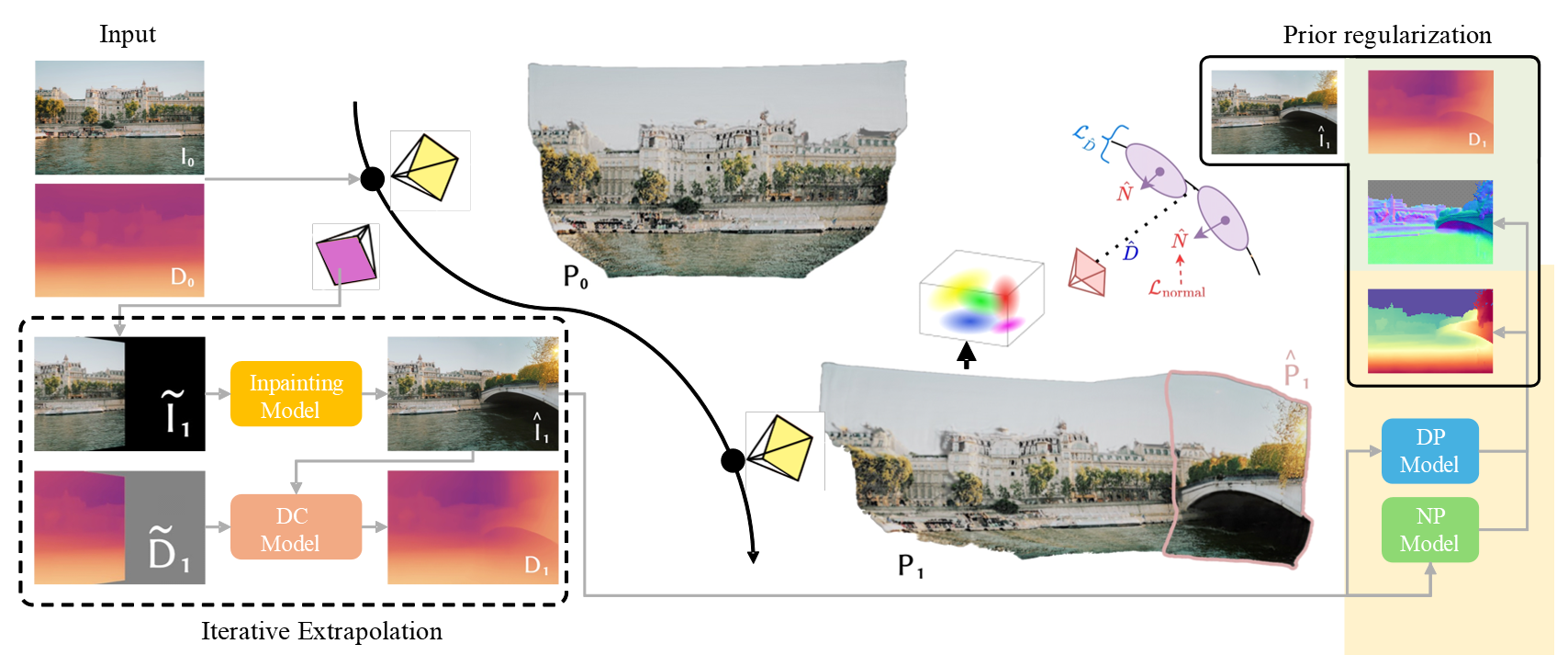
In recent years, with the rapid development of immersive applications, generating 3D scenes from single view image has become an important research topic in computer vision and computer graphics.Compared with reconstruction methods that rely on multi-view images, 3D scene generation from single view image requires only limited input and has a lower barrier to practical application. However, because single view image provides no observations of occluded regions or out-of-view content, the problem is inherently a highly ill-posed inverse problem. Existing iterative extrapolation-based methods can pro-duce visually compelling results, yet error accumulation often leads to geometric artifacts such as curved walls and distorted object proportions.Moreover, commonly used evalu-ation metrics emphasize semantic consistency and perceptual quality, making it difficult to reliably assess the geometric reasonability of generated scenes.To address these issues, this thesis proposes a method for generating 3D scenes from single view image constrained by multi-modal geometric priors. During scene genera-tion, image inpainting and depth completion models are employed for view extrapolation to preserve geometric continuity between newly generated regions and the existing scene.In the 3D reconstruction stage, monocular depth and normals predicted by MoGe2 are further introduced as geometric priors. By jointly constraining the optimization process with multi-modal information, the proposed method reduces geometric ambiguity and im-proves structural reasonability.To overcome the lack of ground-truth geometric evaluation benchmarks in prior work,this thesis constructs a validation dataset in Unreal Engine comprising 10 indoor and 10 outdoor scenes. Multi-view data are collected using an inside-out camera configuration,with ground-truth color images, depth maps, normal maps, camera intrinsic and extrinsic parameters. Furthermore, a geometric evaluation framework transforming the originally open-ended scene generation problem into an evaluation setting with explicit geometric references. Experimental results show that the proposed method outperforms baseline approaches in depth mean absolute error, depth root mean square error, depth Pearson correlation co-efficient, and normal mean error, normal root mean square error, demonstrating that multi-modal geometric priors can effectively improve the geometric reasonability and structural consistency of 3D scene generation from single view image.
 MIS Lab